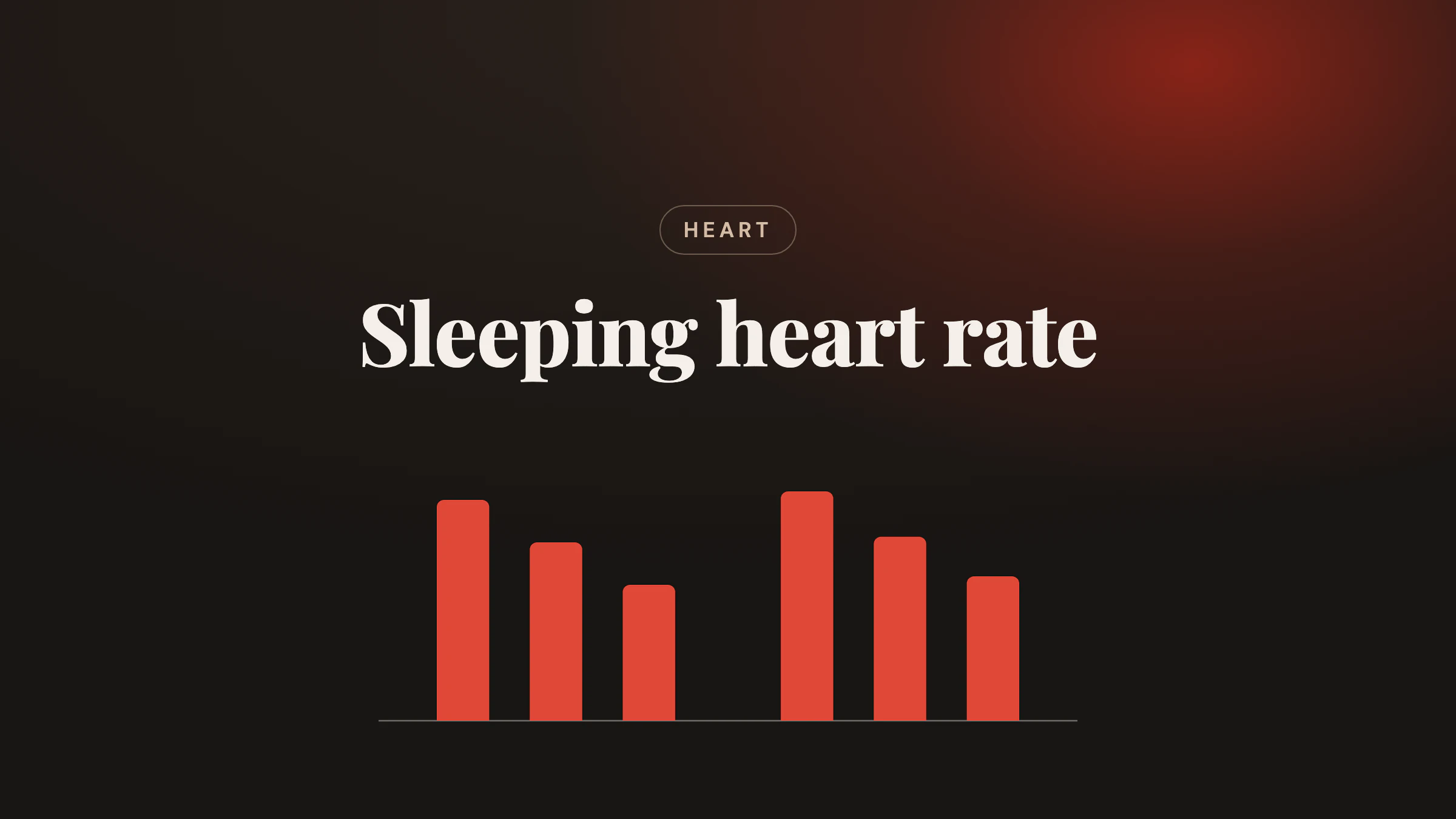
A sleeping heart rate that averages 63 beats per minute (bpm) puts a healthy man aged 50 to 65 at the exact middle of his group. In 24-hour ECGs of 3,942 healthy adults (a Swedish population study), half of the men averaged less than 63 between 10 p.m. and 6 a.m., and half more; for women the middle value was 65. For 95 of 100 men the night average fell between 48 and 83 bpm, for 95 of 100 women between 51 and 83. The slowest single minute is a separate number: it averaged 48 in men and 51 in women.
Key takeaways
1. Sleeping heart rate in healthy adults aged 50 to 65 averaged 63 bpm in men and 65 in women; 95 of 100 lay between 48 (men) or 51 (women) and 83.
2. The lowest minute is another number. It averaged 48 and 51, so “40 to 60” fits the night's lowest values better than a typical night.
3. The night ran 15 to 16 beats below the daytime average, and alcohol raised it with the dose in the first hours of sleep, by up to 8.7 beats.
4. Single nights swing by several beats, so compare weekly medians. A slow night with dizziness, fainting or breathing pauses is a doctor's question.
Normal sleeping heart rate for men and women
A normal sleeping heart rate, taken as the average from 10 p.m. to 6 a.m., covers a wide band in healthy adults aged 50 to 65 (24-hour ECG, 3,942 people). The middle half of men averaged between 57 and 68 bpm, the middle half of women between 60 and 71; the medians were 63 and 65. Ninety-five of 100 sat between 48 and 83 (men) or 51 and 83 (women). The lowest minute averaged 48 and 51.
The people behind these figures: 3,942 adults (2,117 of them women), one 24-hour ECG each, without diabetes, high blood pressure, sleep apnea, heart or lung disease, anemia or beta-blockers. Night is a clock window, so time awake in bed counts; a ring or a watch that averages only sleep reads somewhat lower. The study's authors note that 24-hour heart rate had no agreed normal limits before.
| Percentile | Men | Women |
|---|---|---|
| 2.5th | 48 | 51 |
| 25th | 57 | 60 |
| 50th (median) | 63 | 65 |
| 75th | 68 | 71 |
| 97.5th | 83 | 83 |
| Percentile | Men | Women |
|---|---|---|
| 2.5th | 36 | 39 |
| 25th | 44 | 46 |
| 50th (median) | 48 | 51 |
| 75th | 53 | 55 |
| 97.5th | 63 | 65 |
Worked readings: a night average of 58 sits between the 25th percentile and the median for men, just under the 25th for women. A value of 70 lies between the 75th and 95th percentile for men and just under the 75th for women; 72 lies above the 75th in both sexes, below the 95th. A night of 80 sits at about the 95th percentile in both, still inside the band that held 95 of 100; 90 lies above the 97.5th for both. A lowest minute of 48 is the men's average, yet a night average of 48 sits at their 2.5th percentile.
The often repeated “40 to 60 bpm” sits low in this distribution: about a quarter of women and between a quarter and half of men averaged 60 or less. It fits the lowest minute better.
Women run slightly faster at night, by 2.0 bpm after adjustment for other factors (all 5,021 participants with complete data, not only the healthy group). A meta-analysis of 27 studies of healthy adults with 24-hour ECGs found a shorter interval between beats in women: a slightly faster heart rate.
Sleeping heart rate vs resting heart rate
In the 3,942 healthy adults of the reference study, the night ran 15 bpm (men) and 16 bpm (women) lower than their own daytime average of 78 and 81. In 56,901 patients with high blood pressure, the heart rate taken in a doctor's office sat 10.4 bpm above the night mean. Non-REM sleep and the body clock slow the heart; REM sleep is closer to waking.
A ring or a watch usually shows three numbers that are easy to mix up:
- Night average: the mean across the night; 63 and 65 in the reference men and women.
- Lowest value: the slowest stretch, often a few minutes; the ECG's lowest minute averaged 48 and 51.
- Resting heart rate: a daily value. In a study of 92,457 wrist-tracker users it was meant to represent lying down after waking.
Against that daytime average, the night sat about 19 percent lower in men and 20 percent in women (our arithmetic). The day includes walking, so against seated rest the gap is smaller; the widely quoted “20 to 30 percent below resting” is not what these measurements show.
The studies behind this are small. In non-REM sleep the nervous system shifted to its calming side (14 young healthy adults, three nights in a sleep laboratory); heart rate was higher in REM than in non-REM sleep (26 women, 12 of them with severe premenstrual syndrome). Without sleep, the calming influence kept its 24-hour rhythm (12 adults lying down for 26 hours, once with and once without sleep): part of the slowing is the body clock.
| Group | Day average (beats per minute) | Night average (beats per minute) | Lowest minute (beats per minute) |
|---|---|---|---|
| Men | 78 | 63 | 48 |
| Women | 81 | 65 | 51 |
For the day, see the daytime resting values by age and sex.
Sleeping heart rate by age
Within ages 50 to 65, age showed no measurable association with the night average in the reference study (5,021 people with complete data). In a smaller ECG study across adulthood, heart rate fell with age only slowly, and under 50 women ran faster than men. In 50 young women, the slowest heart rate during sleep ranged from 37 to 59 bpm.
Sample: adults aged 50 to 65. For other ages, the table gives no figure.
The smaller study measured 24-hour averages, not the night alone (260 healthy people aged 10 to 99), and the gap between women and men disappeared after 50.
The same small data set (50 young women without apparent heart disease, published in 1981) puts the fastest sleeping value between 71 and 128 (average 105): short climbs above 100 were common in this healthy group.
The sleeping heart rate charts by age that come up in search cite no ECG study, and some are built from device users' data. Whether a slow or fast night is unsafe is answered in the last section, by symptoms rather than age.
What raises your heart rate at night
Alcohol raised the heart rate in the first hours of sleep with the dose, by up to 8.7 bpm. Fever added about 8.5 bpm per degree Celsius to the 24-hour average and kept it up during sleep. The days around ovulation and the second half of the menstrual cycle added 2.1 and 3.8 bpm against the days of the period. Smoking, a BMI above 30 and little physical activity went with higher night values.
The alcohol data come from 4,098 Finnish employees (mean age 45), each compared with their own nights without alcohol. In the first 3 hours of sleep, heart rate ran 1.4 bpm higher after a low dose (up to 0.25 g of alcohol per kg of body weight), 4.0 after a moderate one and 8.7 above 0.75 g per kg. Younger people showed larger rises.
As an example, take a person of 70 kg (about 154 lb): the low band stops at 17.5 g of alcohol, the high band begins above 52.5 g. Two 12-ounce beers at 5 percent, about 14 g each, make roughly 28 g: the moderate band. A 5-ounce glass of 12 percent wine also carries about 14 g.
The fever figure comes from 27 young men with an acute infection (24-hour ECG during the fever and after recovery: 84.0 bpm with fever, 66.5 after it).
The cycle figures come from 91 women aged 22 to 42 (274 cycles with ovulation, pulse taken in sleep by a wrist sensor); the 3.8 is the mid-luteal phase.
In the reference study (5,021 people, each factor adjusted for the others), night values ran 3.7 bpm higher in current smokers, 2.9 higher with a BMI above 30 (against under 25), 2.5 higher with diabetes, 1.0 higher with alcohol above the median, 3.3 lower with high physical activity against low (see cardio and strength training together) and 1.8 lower with beta-blockers. These are associations between people, not effects of changing a habit, and all the factors in the model together explained less than 15 percent of the differences.
| Cause | Rise, beats per minute | Who was studied |
|---|---|---|
| after a high alcohol dose, above 0.75 g per kg, first 3 hours of sleep | +8.7 | 4,098 Finnish employees |
| per 1 °C of fever, over 24 hours, high in sleep too | +8.5 | 27 young men with an infection |
| mid-luteal phase, against the days of the period | +3.8 | 91 women aged 22 to 42 |
Alcohol is the factor a person can change on the evening itself; what lowers the resting value over months is in how to lower resting heart rate.
How much night-to-night change is normal
A person's lowest sleeping heart rate varied by about 8 bpm between nights with unchanged training (10 women, three nights in three weeks), and 1 in 5 of 92,457 tracker users had at least one week in which the device's daily resting value swung by 10 bpm or more. A tested smart ring agreed closely with ECG at night, best as a whole-night average. Compare weekly medians with your own earlier weeks.
Against a chest ECG at home (35 healthy adults, one night each), a smart ring's heart rate agreed closely, more so for the whole-night average than for 5-minute readings. In two sleep-laboratory studies (114 adults: 92 under 45, 22 aged 45 or older), the ring agreed strongly with ECG in both age groups, and longer averaging windows improved accuracy.
As an example, take seven night averages: 58, 61, 57, 66, 59, 58 and 60 bpm. The median is 59, the mean 59.9; the 66 followed an evening with wine. The median, not the highest night, is the number to carry forward.
To read your own nights, compare like with like (night average with night average, lowest value with lowest value) on one device. Take the median of a week, and count a change as real only when it moves by more than the ordinary swing for several weeks. Place it in the table only roughly: the table's night is a clock window measured by ECG.
If your watch already tracks your nights, your huuman Coach reads your Apple Health, sleep stages and resting heart rate included, and plans every session into your week.
What a high sleeping heart rate says about your health
In cohort studies, a higher night value and a smaller nightly dip went with more deaths or cardiovascular events, in some studies more closely than the daytime value. In pooled population cohorts, heart rate added little to the usual risk factors for predicting heart attacks and strokes; the night-to-day ratio was the exception. The night value is a marker of fitness, weight, alcohol, illness and sleep problems, not a target.
In 653 adults aged 55 to 75 without apparent heart disease (48-hour ECG, night value from 15 minutes at 2 a.m., median 76 months), night-time heart rate was the only one of three heart-rate measures still linked to cardiovascular events after adjustment. In 7,600 untreated patients with high blood pressure (median 5 years), 10 bpm more at night went with a 13 percent higher cardiovascular risk; daytime heart rate was not significantly associated. In the 56,901 patients with high blood pressure, a night mean over 90 showed the strongest link with death from any cause, stronger than an office, day or 24-hour value over 90.
The dip points the same way. In 3,957 patients referred for 24-hour blood pressure monitoring, the tenth with the smallest nightly drop had 2.67 times the risk of death of the tenth with the largest. In 457 patients treated or evaluated for high blood pressure (about 6 years), a nightly fall of less than 10 percent went with 2.37 times the risk of stroke, heart attack or sudden cardiac death. Total mortality: not significantly higher. In 2,021 adults of a general-population study (about 12 years), the quarter with the smallest drop had 1.8 times the risk of cardiovascular events of the quarter with the largest.
The counterweight comes from 6,928 people in six population studies (median 9.6 years): a higher night value went with higher mortality, yet heart rate added little to cardiovascular prediction, the night-to-day ratio apart.
| Measure | Value | Who was studied |
|---|---|---|
| higher cardiovascular risk, per 10 bpm higher at night | 13% | 7,600 untreated patients with high blood pressure |
| risk of death, smallest vs largest dip, (tenths of the group) | 2.67× | 3,957 patients referred for 24-hour monitoring |
| cardiovascular risk, smallest vs largest dip, (quarters of the group) | 1.8× | 2,021 adults, general population |
None of these cohorts tested lowering the night value. A high reading points to what raises it, not to a target of its own.
When a low or high sleeping heart rate needs a doctor
A slow sinus rhythm is the most common slow rhythm in sleep and, on its own, no reason for a pacemaker; some healthy adults recorded lowest minutes in the high 30s. A slow night needs a doctor when dizziness, fainting, unusual tiredness or breathing pauses come with it, as does a night average well above the table for weeks, or an irregular pulse.
The US bradycardia guideline counts under 60 bpm as slow in adults other than well-trained athletes (population studies often use 50) and sets no separate cut-off for the night. A vagal heart block in sleep is almost always without symptoms.
In the reference study, 2.5 of 100 men had a lowest minute of 36 or less (women: 39). Among 50 young women, the lowest value in sleep went down to 37. In 50 healthy male medical students, slow rhythms were common, including a brief heart block at night in 3 of them (6 percent). A lowest minute of 44 sits at the men's 25th percentile and between the 5th and 25th for women; 48 is the men's average.
The guideline adds that slow rhythms at night should prompt a check for sleep apnea. In a meta-analysis of 34 studies (4,852 patients), about 70 of 100 people with sleep apnea had slow heart rhythms at night, and about 57 of 100 with a slow rhythm had sleep apnea; both estimates have very wide intervals.
Read your own number against your earlier weeks first and the table second; a change is real when the weekly median stays shifted for weeks.
More health topics to explore
- Heart health guides
- Resting heart rate chart by age and sex
- HRV tool: check your heart rate variability
References
- Persson AP et al. — Reference ranges for ambulatory heart rate measurements in a middle-aged... (2024)
- De Maria B et al. — Day and night heart rate variability using 24-h ECG recordings: a systematic... (2023)
- Böhm M et al. — Association of clinic and ambulatory heart rate parameters with mortality in... (2020)
- Quer G et al. — Inter- and intraindividual variability in daily resting heart rate and its... (2020)
- Trinder J et al. — Autonomic activity during human sleep as a function of time and sleep stage (2001)
- de Zambotti M et al. — Autonomic regulation across phases of the menstrual cycle and sleep stages... (2013)
- Burgess HJ et al. — Sleep and circadian influences on cardiac autonomic nervous system activity (1997)
- Umetani K et al. — Twenty-four hour time domain heart rate variability and heart rate:... (1998)
- Sobotka PA et al. — Arrhythmias documented by 24-hour continuous ambulatory electrocardiographic... (1981)
- Pietilä J et al. — Acute Effect of Alcohol Intake on Cardiovascular Autonomic Regulation During... (2018)
- Karjalainen J et al. — Fever and cardiac rhythm (1986)
- Shilaih M et al. — Pulse Rate Measurement During Sleep Using Wearable Sensors, and its... (2017)
- Waldeck MR et al. — Heart rate during sleep: implications for monitoring training status (2003)
- Cao R et al. — Accuracy Assessment of Oura Ring Nocturnal Heart Rate and Heart Rate... (2022)
- Liang T et al. — Deriving Accurate Nocturnal Heart Rate, rMSSD and Frequency HRV from the... (2024)
- Johansen CD et al. — Resting, night-time, and 24 h heart rate as markers of cardiovascular risk... (2013)
- Palatini P et al. — Predictive value of night-time heart rate for cardiovascular events in... (2013)
- Ben-Dov IZ et al. — Blunted heart rate dip during sleep and all-cause mortality (2007)
- Eguchi K et al. — Nocturnal nondipping of heart rate predicts cardiovascular events in... (2009)
- Cuspidi C et al. — Night-time heart rate nondipping: clinical and prognostic significance in... (2018)
- Hansen TW et al. — Prognostic value of ambulatory heart rate revisited in 6928 subjects from 6... (2008)
- Kusumoto FM et al. — 2018 ACC/AHA/HRS Guideline on the Evaluation and Management of Patients With... (2019)
- Brodsky M et al. — Arrhythmias documented by 24 hour continuous electrocardiographic monitoring... (1977)
- Teo YH et al. — Prevalence, types and treatment of bradycardia in obstructive sleep apnea -... (2022)
About this article · Written by the huuman Team. Our content is based on peer-reviewed research and clinical guidelines. We follow editorial standards grounded in scientific evidence.
This article is for educational purposes only and does not constitute medical advice. Health and training decisions should be discussed with qualified professionals.