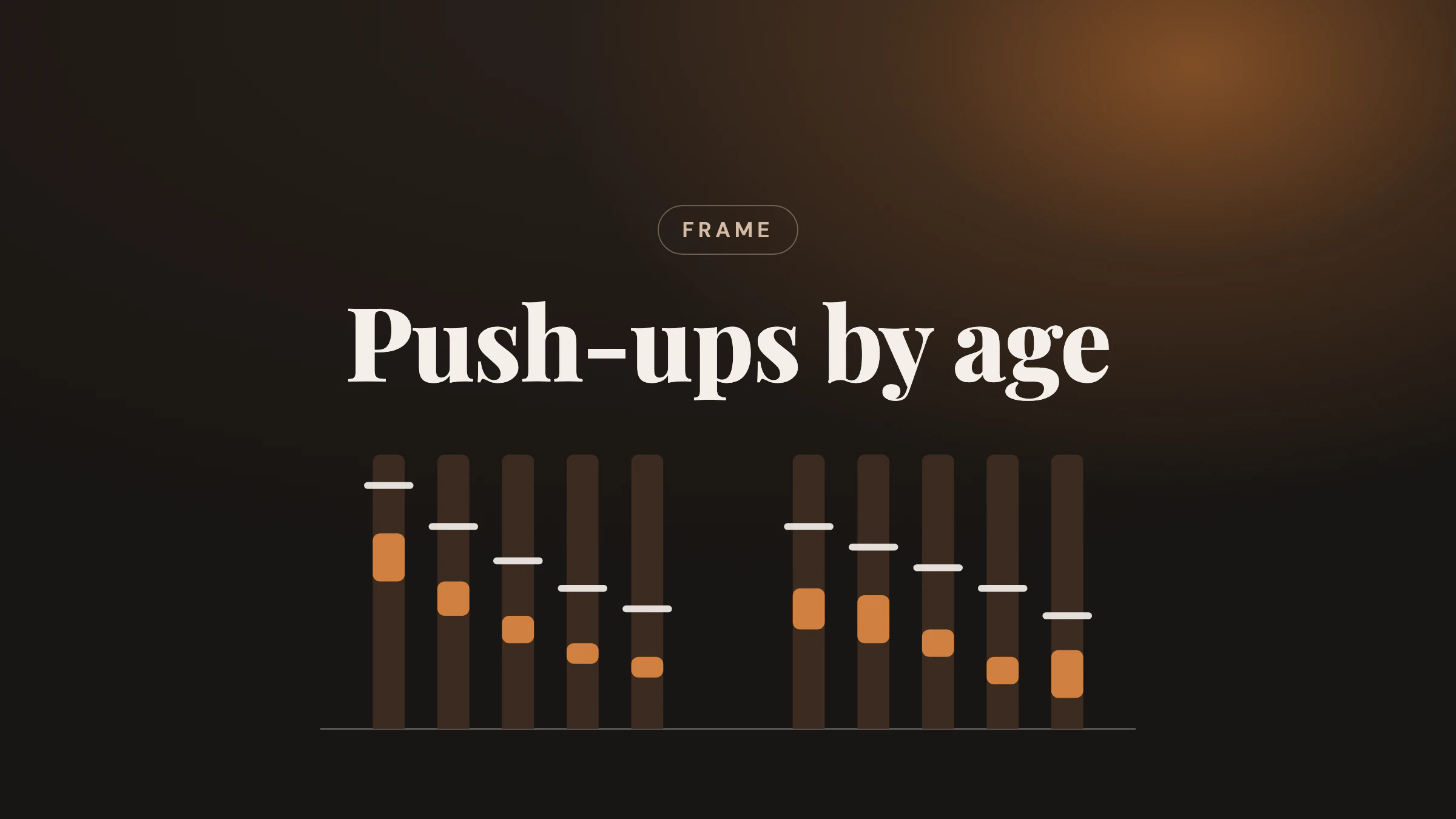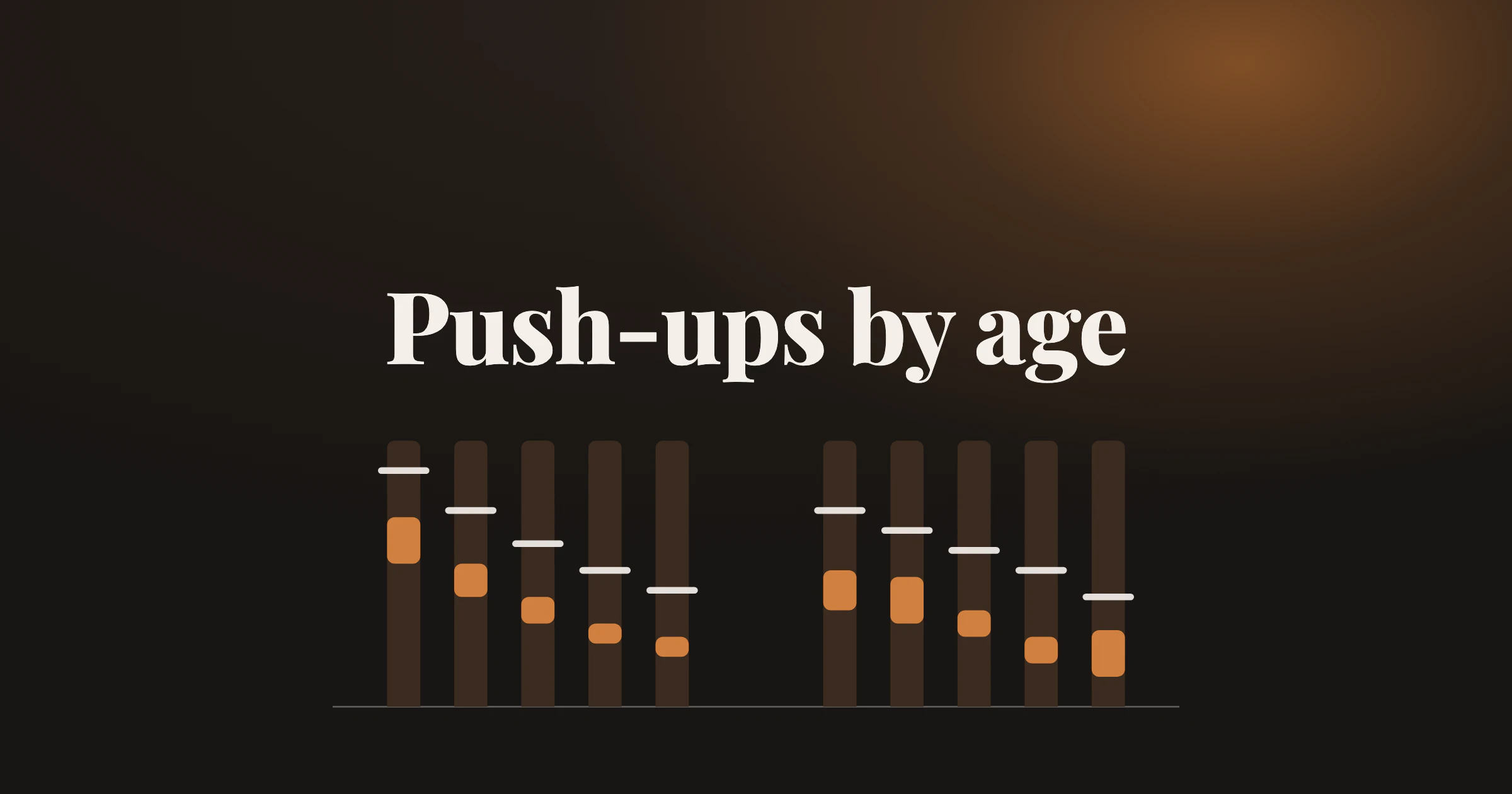
Fourteen push-ups in one set land in the “good” band for a man aged 40 to 49 (13 to 16) and for a woman of the same age on knee push-ups (11 to 14). Both bands come from Canadian norms published in 2003, which rate one set without rest. The table below shows how many push-ups you should be able to do in each age band from 20 to 69.
Key takeaways
1. How many push-ups you should be able to do falls with each decade: at 50 to 59, “good” is 10 to 12 for men and 7 to 10 knee push-ups for women.
2. The test is one strict set without rest; the women's values are knee push-ups.
3. A count marks fitness and is no heart test: the “96 percent” study covered 1,104 male firefighters, and its authors do not call the count an independent predictor.
4. Doing more takes 2 to 3 sessions a week, sets short of failure and one ladder step at a time.
Push-ups by age: the table for men and women
This push-up table is the Canadian Society for Exercise Physiology's norm set (2003), reprinted by the American Council on Exercise. It sorts one set without rest into five ratings, from “needs improvement” to “excellent”, for ages 20 to 69 (men on standard push-ups, women on knee push-ups). These are ratings, not averages; the table does not say what the average person can do.
| Age | Men: good | Men: excellent from | Women, knee push-ups: good | Women, knee push-ups: excellent from |
|---|---|---|---|---|
| 20 to 29 | 22 to 28 | 36 | 15 to 20 | 30 |
| 30 to 39 | 17 to 21 | 30 | 13 to 19 | 27 |
| 40 to 49 | 13 to 16 | 25 | 11 to 14 | 24 |
| 50 to 59 | 10 to 12 | 21 | 7 to 10 | 21 |
| 60 to 69 | 8 to 10 | 18 | 5 to 11 | 17 |
- How to test: Warm up, rest two minutes, then as many full push-ups as you can with a rigid trunk and the chest touching a fist or rolled towel.
- Stop at the first failed repetition or the second in a row with broken form.
- Skip the test with shoulder, elbow or wrist problems.
| Age | Excellent | Very good | Good | Fair | Needs improvement |
|---|---|---|---|---|---|
| Men, standard push-ups | |||||
| 20 to 29 | 36 or more | 29 to 35 | 22 to 28 | 17 to 21 | 16 or fewer |
| 30 to 39 | 30 or more | 22 to 29 | 17 to 21 | 12 to 16 | 11 or fewer |
| 40 to 49 | 25 or more | 17 to 24 | 13 to 16 | 10 to 12 | 9 or fewer |
| 50 to 59 | 21 or more | 13 to 20 | 10 to 12 | 7 to 9 | 6 or fewer |
| 60 to 69 | 18 or more | 11 to 17 | 8 to 10 | 5 to 7 | 4 or fewer |
| Women, knee push-ups | |||||
| 20 to 29 | 30 or more | 21 to 29 | 15 to 20 | 10 to 14 | 9 or fewer |
| 30 to 39 | 27 or more | 20 to 26 | 13 to 19 | 8 to 12 | 7 or fewer |
| 40 to 49 | 24 or more | 15 to 23 | 11 to 14 | 5 to 10 | 4 or fewer |
| 50 to 59 | 21 or more | 11 to 20 | 7 to 10 | 2 to 6 | 1 or fewer |
| 60 to 69 | 17 or more | 12 to 16 | 5 to 11 | 2 to 4 | 1 or fewer |
A category, not a health verdict. Retest the same way in 4 to 6 weeks; as a rule of thumb, a gain of 2 or more is real progress.
Age band and sex pick the row, the count picks the column:
| Age and sex | Excellent | Very good | Good | Fair | Needs improvement |
|---|---|---|---|---|---|
| Men 20 to 29 | 36 or more | 29 to 35 | 22 to 28 | 17 to 21 | 16 or fewer |
| Men 30 to 39 | 30 or more | 22 to 29 | 17 to 21 | 12 to 16 | 11 or fewer |
| Men 40 to 49 | 25 or more | 17 to 24 | 13 to 16 | 10 to 12 | 9 or fewer |
| Men 50 to 59 | 21 or more | 13 to 20 | 10 to 12 | 7 to 9 | 6 or fewer |
| Men 60 to 69 | 18 or more | 11 to 17 | 8 to 10 | 5 to 7 | 4 or fewer |
| Women 20 to 29 | 30 or more | 21 to 29 | 15 to 20 | 10 to 14 | 9 or fewer |
| Women 30 to 39 | 27 or more | 20 to 26 | 13 to 19 | 8 to 12 | 7 or fewer |
| Women 40 to 49 | 24 or more | 15 to 23 | 11 to 14 | 5 to 10 | 4 or fewer |
| Women 50 to 59 | 21 or more | 11 to 20 | 7 to 10 | 2 to 6 | 1 or fewer |
| Women 60 to 69 | 17 or more | 12 to 16 | 5 to 11 | 2 to 4 | 1 or fewer |
How to do the push-up test properly
The test is one set to the limit, without rest. A repetition counts only with a rigid trunk, arms fully straight at the top and the chest touching a fist or rolled towel at the bottom. The set ends at the first failed repetition or the second in a row with broken form. Ratings apply only to the table's version, standard push-ups for men and knee push-ups for women.
Strict rules keep counts comparable. In a rater study (8 raters, the same 15 videotaped 2-minute Army tests), the overall scores varied between 3.0 and 35.7 push-ups. In a retest study (46 of 180 adults, a 15-second push-up test repeated within 5 days), scores matched closely; only a change of 2 repetitions or more exceeded measurement noise. A count that dropped after weeks off is expected: our timeline shows how long it takes to lose muscle.
How many push-ups should a woman be able to do?
In the Canadian norms, “good” for women means 15 to 20 knee push-ups at ages 20 to 29 and 5 to 11 at ages 60 to 69. The knee version is a convention of the protocol, not a limit: women who can do several standard push-ups are still tested from the knees. The 2022 study that notes this (72 college-aged women, mean 9 standard and 17.5 knee push-ups) calls the ratings more than 30 years old.
On the same program, women gained at least as much upper-body strength as men relative to their starting level (17 studies in young and middle-aged adults). Our advice is to rate on knee push-ups and track progress on the version actually trained.
What your push-up count says about your health
A push-up count is a fitness marker, not a heart test. The “96 percent” headline comes from one cohort (1,104 male firefighters, mean age 39.6, 10-year follow-up). Cardiovascular events: 37 in all, one of them among the men with more than 40 push-ups. Compared with the 0 to 10 group, that is a much lower event rate (unadjusted rate ratio 0.04, hence “96 percent”). The authors write that the results do not support push-up capacity as an independent predictor.
| Push-ups at the start | Men | Mean age in years |
|---|---|---|
| 0 to 10 | 75 | 48.4 |
| 11 to 20 | 200 | 45.1 |
| 21 to 30 | 389 | 39.0 |
| 31 to 40 | 285 | 36.6 |
| 41 or more | 155 | 35.1 |
Unadjusted means no correction for differences such as age: the men with 0 to 10 push-ups averaged 48.4 years, those with 41 or more 35.1, a gap of about 13 years. With age and BMI corrected for, the difference between these two groups was not statistically significant (p = 0.07). The authors caution that the results may not apply to women or to older or inactive people.
The count does reflect fitness. In 846 young men (mean age 25.5), push-up counts rose with maximal bench press strength (correlation 0.61) and tracked aerobic fitness (norms in our VO2max chart by age) and lower body fat. Mortality (8,116 Canadian adults aged 20 to 69, followed for 13 years): no pattern of higher risk across four push-up groups. Strength training as a whole has firmer evidence: a meta-analysis of cohort studies links it to a 10 to 17 percent lower risk of death and cardiovascular disease.
How to do more push-ups
Our rule for more push-ups: 2 to 3 sessions a week, 3 sets each, at the hardest ladder step that allows 8 clean repetitions, every set stopped 1 to 3 repetitions before failure. At 3 sets of 12 to 15, move one step up. The WHO guideline asks adults for muscle strengthening on at least 2 days a week. In one review (15 studies, all in young adults), training to failure did not seem necessary for strength or muscle gains.
The ladder rests on force-plate measurements (23 adults), in which hands raised or knees down was lighter than a standard push-up and feet raised heavier. In one small trial (23 moderately trained young men, 3 days a week, 4 weeks), progressive push-ups raised the bench press maximum, as bench press training did. Adults aged 50 and older gained 24 percent in chest press strength on average with resistance training (a review of 47 studies).
Push-ups cover one of the five basic movements; the full weekly plan is in our guide to building muscle after 40. If you would rather not plan the steps yourself, your huuman Coach plans every session into your week.
Common questions
Is 20 push-ups in a row decent?
For men, 20 push-ups are “fair” at 20 to 29, “good” at 30 to 39, “very good” from 40 to 59 and “excellent” at 60 to 69. On knee push-ups, 20 is “good” for women at 20 to 29, “very good” from 30 to 59 and “excellent” at 60 to 69. And 40 is “excellent” in every band; so is 30, except for men aged 20 to 29.
How many push-ups can an average person do?
The standard table cannot say, because it gives ratings, not averages, and the reprint does not describe who was measured. “Good” is the middle of its five ratings; at 30 to 39 it means 17 to 21 push-ups for men and 13 to 19 knee push-ups for women.
How many push-ups can an average 70-year-old man do?
The standard table has no row for it; it stops at 69. For ages 60 to 94, separate fitness standards with their own tests (built on 2,140 adults and long-term studies) describe the level linked to staying physically independent. Past 69, compare a push-up count with your own earlier results (our advice).
Will 100 push-ups every day build muscle?
Push-ups can build muscle. In one trial (18 men aged 19 to 22, twice a week, 8 weeks), push-ups and a light bench press of matched load were comparably effective for muscle growth and strength. Progress comes from effort and harder variations, not a daily quota: 2 to 3 sessions a week, each set short of failure.
More health topics to explore
- Frame: strength and muscle guides
- One-rep max calculator
- The five longevity biomarkers
- Building muscle after 40
References
- American Council on Exercise — ACE Group Fitness Instructor Fitness Assessment Protocols
- Fielitz L et al. — Inter-Rater Reliability and Intra-Rater Reliability of Assessing the... (2016)
- Negrete RJ et al. — Reliability, minimal detectable change, and normative values for tests of... (2010)
- Adams MM et al. — Development of a Standard Push-up Scale for College-Aged Females (2022)
- Roberts BM et al. — Sex Differences in Resistance Training: A Systematic Review and Meta-Analysis (2020)
- Yang J et al. — Association Between Push-up Exercise Capacity and Future Cardiovascular... (2019)
- Vaara JP et al. — Associations of maximal strength and muscular endurance test scores with... (2012)
- Katzmarzyk PT et al. — Musculoskeletal fitness and risk of mortality (2002)
- Momma H et al. — Muscle-strengthening activities are associated with lower risk and mortality... (2022)
- Bull FC et al. — World Health Organization 2020 guidelines on physical activity and sedentary... (2020)
- Grgic J et al. — Effects of resistance training performed to repetition failure or... (2022)
- Ebben WP et al. — Kinetic analysis of several variations of push-ups (2011)
- Kotarsky CJ et al. — Effect of Progressive Calisthenic Push-up Training on Muscle Strength and... (2018)
- Peterson MD et al. — Resistance exercise for muscular strength in older adults: a meta-analysis (2010)
- Rikli RE et al. — Development and validation of criterion-referenced clinically relevant... (2013)
- Kikuchi N et al. — Low-load bench press and push-up induce similar muscle hypertrophy and... (2017)
About this article · Written by the huuman Team. Our content is based on peer-reviewed research and clinical guidelines. We follow editorial standards grounded in scientific evidence.
This article is for educational purposes only and does not constitute medical advice. Health and training decisions should be discussed with qualified professionals.