How to improve VO2max is a question controlled trials answer in a single unit: milliliters of oxygen per kilogram of body weight per minute (mL/kg/min), measured in a lab at all-out effort. Below, steady work, intervals, sprints and strength training stand side by side, each with the people actually studied. In 28 trials of adults aged 18 to 45, both steady work and intervals raised it, and intervals added a possibly small 1.2 mL/kg/min. In middle-aged and older adults their edge was a significant 1.10. A five-year trial of people aged 70 to 77 used two 4x4 sessions a week.
Key takeaways
1. How to improve VO2max: trained groups gained about 3.6 to 5.5 mL/kg/min over groups that did not train, and intervals about 1 more than steady work.
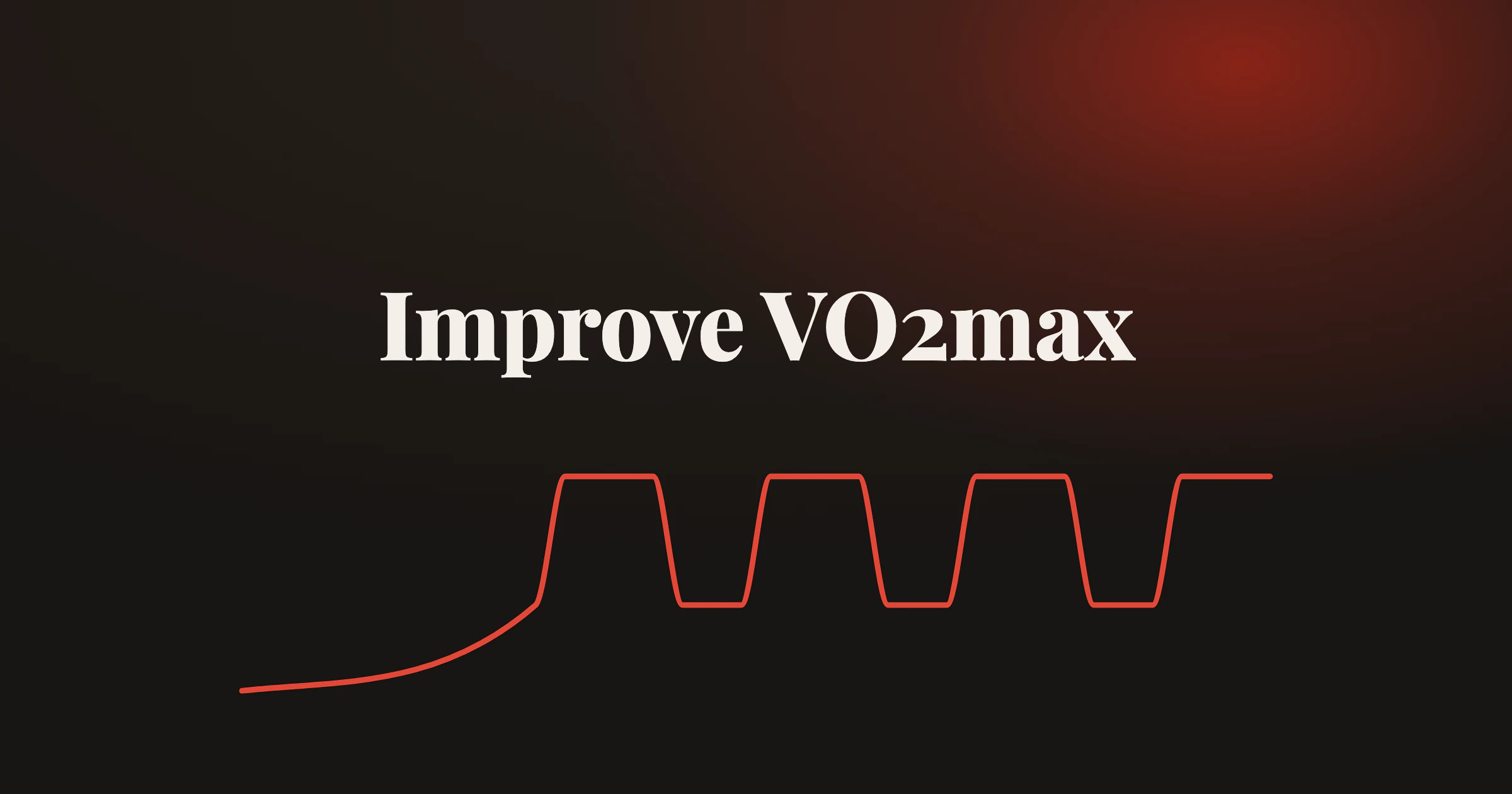
2. The 4x4: four hard 4-minute blocks with 3 easy minutes between, 2 to 3 times a week; the trial at ages 70 to 77 used 2.
3. In sedentary groups averaging 60 or more, the trial gain was about one age decade's worth in US reference data.
4. In two dose trials, more or harder training left no one without a gain.
5. One watch reading can sit about 10 points from the lab value, so read the trend over 8 to 12 weeks.
Which training improves VO2max most: the trial numbers
Steady work, intervals and sprints all raised VO2max in pooled trials. Over not training, pooled gains ranged from about 3.6 to 5.5 mL/kg/min, depending on who was studied. Intervals added about 1 mL/kg/min more than steady work in young adults and again in middle-aged and older ones. In adults 60 and over, and in trials of women, the two modes were not significantly different.
| Training and group | mL/kg/min |
|---|---|
| Intervals, adults 18 to 45 (28 trials) | 5.5 |
| Steady endurance, adults 18 to 45 | 4.9 |
| Endurance, sedentary groups averaging 60+ (41 trials) | 3.78 |
| Endurance plus strength, ages 54 to 85 (27 studies) | 3.6 |
| 30-second sprints, young adults (16 trials) | 3.6 |
| Extra gain from intervals over steady training: Adults 18 to 45 | 1.2 |
| Extra gain from intervals over steady training: Middle-aged and older (14 studies) | 1.1 |
Young adults first (28 controlled trials, 723 people aged 18 to 45): steady work added 4.9 mL/kg/min over controls and intervals 5.5, a gap the authors called possibly small. Sprints of 30 seconds all out (16 trials, average age 23.5) added about 3.6 mL/kg/min, roughly 8 percent, and were not significantly different from endurance training.
In 14 studies of 429 middle-aged and older adults, intervals beat steady work by 1.10 mL/kg/min (gains from baseline of 2.26 and 1.34). In 41 controlled trials of 2,102 sedentary people averaging 60 or more, endurance training added 3.78 mL/kg/min over controls, or 16.3 percent.
In 29 trials of 1,227 adults aged 60 and over (average 65.4), the effect size was moderate for intervals (0.72) and small to moderate for steady work (0.49), a gap that was not significant; in the subset with control groups, only the interval groups gained. In women, gains from baseline of 3.20 with continuous training and 3.16 with intervals were not significantly different, and more sessions helped both.
The 4x4 interval session, with heart rates by age
The 4x4 is a warm-up of about 10 minutes, then four 4-minute blocks at 90 to 95 percent of maximum heart rate, with 3 easy minutes at about 70 percent between them. Moderately trained young men gained 7.2 percent in 8 weeks at three sessions a week; people aged 70 to 77 did two a week for five years. Formula heart rates are a start; an effort of about 16 on a 6 to 20 scale decides.
| Age | Max (formula) | Hard blocks | Easy minutes |
|---|---|---|---|
| 55 | About 170 | 153 to 161 | About 119 |
| 65 | About 163 | 146 to 154 | About 114 |
The 7.2 percent comes from 40 young men randomized to four protocols with equal total work, where the 4x4 beat the same work done steadily. Generation 100 (1,567 people, average age 72.8) prescribed about 90 percent of peak heart rate, or 16 on the Borg scale (6 is no effort, 20 is maximal). After five years, peak oxygen uptake was 0.7 mL/kg/min above an active control. The controls also exercised, and only about half of the interval group kept to the plan.
Maximum heart rate (the rate at exhaustion) can be estimated as 208 minus 0.7 times age, a formula from a 2001 analysis of 351 studies. As an example, that gives about 170 beats per minute at 55, so hard minutes at about 153 to 161 and easy ones near 119; at 65 it gives about 163, with hard minutes at 146 to 154 and easy ones near 114. In 1,208 adults averaging 62, such formulas were typically off by 10 to 12 beats, tending to read too high.
Longer blocks count. In a meta-analysis of 53 trials, the bigger gains came with intervals lasting 2 minutes or more, 15 or more hard minutes a session and 4 to 12 weeks or longer. As an example week: start with one 4x4 and one easy session, build over a few weeks to two 4x4s and one longer easy session, and add two strength sessions on other days or after the endurance part. Judge it after 12 weeks. More formats: VO2max protocols compared.
Zone 2, 80/20 and strength training: what they add
Easy steady work raised VO2max in sedentary people averaging 67, starting at 35 to 50 percent of heart rate reserve. On the muscle measures it is promoted for, a review did not back Zone 2 as the best intensity for everyone, and in trained athletes an 80/20 split was not significantly better than other splits. Strength training alone added less than aerobic work, but combined with it the gain held.
The dose data (steady training, 1,257 exercisers and 845 controls) show gains starting at 35 to 50 percent of heart rate reserve (the span from resting to maximum heart rate), peaking around 66 to 73 percent, with sessions of 40 to 50 minutes on 3 to 4 days over 30 to 40 weeks. A 2025 narrative review, which judged muscle mitochondria and fat burning rather than VO2max, did not find Zone 2 to be best for the general public. Among 348 endurance athletes in 13 studies, a polarized split showed no significant advantage. Easy targets: Zone 2 heart rate calculator.
In 38 trials of 1,682 middle-aged and older adults, aerobic work lifted VO2max 1.80 mL/kg/min more than strength training, which built more lean mass. Paired in one session (27 studies, ages 54 to 85), endurance plus strength added 3.6 over no exercise and a small 0.8 over endurance alone, with wide limits. More in cardio and strength training together and strength training after 40.
How much VO2max can be gained after 40 and after 60
VO2max falls with age, and faster later in life. In sedentary groups averaging 60 or more, endurance training added 3.78 mL/kg/min over controls, close to the 4.0 between neighboring age decades in US reference data. A two-year program at an average age of 53 raised it by 5.4 in the training group. These are sizes set side by side, not years taken off.
| Comparison | mL/kg/min |
|---|---|
| One decade of age, US reference data | 4.0 |
| Endurance training, sedentary groups averaging 60+ | 3.78 |
| Two years of training, average age 53 | 5.4 |
Followed over years, 810 healthy adults aged 21 to 87 lost 3 to 6 percent per decade in their 20s and 30s and over 20 percent per decade from their 70s, whatever their leisure activity. The US FRIEND registry (22,379 lab tests, ages 20 to 89) gives the cross-sectional step, 4.0 mL/kg/min or 13.5 percent per decade, comparing different people rather than the same ones over time.
The two-year trial (61 sedentary adults, 53 finished) built up to 5 to 6 hours a week, with two interval and two strength sessions. VO2max rose from 29.0 to 34.4 mL/kg/min, or 18 percent; controls doing yoga and balance slipped from 29.5 to 28.7. That gain is about one and a third decades, the 3.78 about 0.94 of one.
In an overview of cohort meta-analyses, adults with high fitness had about half the risk of death of those with low fitness (hazard ratio 0.47), and each extra MET (a unit of exercise capacity) went with an 11 to 17 percent lower risk. Fitter people died less often, which does not prove that training causes the difference. What counts as good depends on age and sex: VO2max chart by age; for the pulse, see how to lower your resting heart rate.
How fast VO2max rises, and how fast it fades
In 53 trials, even 4 weeks or less of short intervals raised VO2max, and 4 to 12 weeks or more did more; in sedentary groups averaging 60 or more, gains were larger in programs past 20 weeks. Stopping costs it quickly: in one small study, trained people lost 7 percent in 21 days. A watch jump of many points in a few weeks is bigger than the pooled trial gains of 3.6 to 5.5.
The fade figures come from one study (7 endurance-trained people, followed for 84 days after they stopped): VO2max dropped 7 percent by day 21 and settled 16 percent lower by day 56, still above never-trained people. So a plan needs about 12 weeks before its result is read, and real progress looks like a steady climb over months.
Non-responders: what the dose trials found
In two trials, the share who did not improve fell to zero as dose or intensity rose, and in one, everyone improved after two extra sessions a week. Pooling 1,879 people, an analysis found that measurement error and what people actually did likely explain most of the spread in results. Genes play a part, but “non-responder” labels a result in one trial, not a person.
| Trial and group | % who did not improve |
|---|---|
| 24 weeks, 5 sessions a week, 121 sedentary adults with abdominal obesity (average age 53): Small amount, easy | 38.5 |
| 24 weeks, 5 sessions a week, 121 sedentary adults with abdominal obesity (average age 53): Large amount, easy | 17.6 |
| 24 weeks, 5 sessions a week, 121 sedentary adults with abdominal obesity (average age 53): Large amount, harder | 0 |
| 6 weeks, 60-minute sessions, 78 healthy adults: 1 a week | 69 |
| 6 weeks, 60-minute sessions, 78 healthy adults: 2 a week | 40 |
| 6 weeks, 60-minute sessions, 78 healthy adults: 3 a week | 29 |
| 6 weeks, 60-minute sessions, 78 healthy adults: 4 a week | 0 |
| 6 weeks, 60-minute sessions, 78 healthy adults: 5 a week | 0 |
Over 24 weeks of five weekly sessions, 121 sedentary adults with abdominal obesity (average age 53) were randomized to three doses. No fitness gain appeared in 38.5 percent on the small easy dose, and in none on the large, harder one (75 percent of peak oxygen uptake, not intervals). In 78 healthy adults doing one to five 60-minute sessions a week for 6 weeks, 69 percent at one session did not improve in maximal power, and every non-responder did after 6 more weeks with two extra sessions a week.
The 2022 pooled analysis (individual data, 8 randomized trials) found little evidence that trainability differs much, and its authors advise programs known for large average gains, which raise each person's odds of improving. An expert consensus statement found strong evidence that responses differ on the same dose, partly through genes. In these trials a non-responder is someone whose gain stayed within measurement error.
Reading a watch's VO2max, and why it can drop while training
A watch's VO2max is an estimate. In a meta-analysis of 14 validation studies, exercise-based estimates were right on average, yet one person's reading could land about 10 mL/kg/min from the lab value in either direction. A drop during training has ordinary causes, from body weight to workouts the watch does not count. The trend over 8 to 12 weeks on one device is the number to read.
Average bias was -0.09 mL/kg/min, while resting-based estimates ran 2.17 high and scattered more. The 10-point limits describe one estimate against the lab, not week-to-week drift. An Apple Watch Series 7 missed by 15.8 percent on average in 19 adults aged 18 to 63, average 28 (41.4 against 45.9 on a lab bike), high in less fit people and low in very fit ones. A Garmin fenix 6 erred by about 7 percent in 19 healthy adults. Apple's current estimate uses outdoor walks, runs and hikes, ignores indoor workouts and factors in weight and heart-rate-limiting medicines.
Reasons a value falls or stalls during training, each with a source: a break or lighter load, a dose too small or too easy, more body weight, uncounted workouts, single-estimate error and the slow decline with age. As an example: 2.8 liters of oxygen a minute is 35.0 mL/kg/min at 80 kg (about 176 lb), 36.8 at 76 kg and 33.3 at 84 kg, nearly 2 points with no change in heart or muscle.
To read your own number, compare 8 to 12 weeks on the same device and give it outdoor sessions it can use. A VO2max calculator adds a second estimate, not a measurement.
More health topics to explore
- Heart guides
- VO2max chart by age
- How to lower your resting heart rate
- Cardio and strength training together
References
- Milanović Z et al. — Effectiveness of High-Intensity Interval Training (HIT) and Continuous... (2015)
- Poon ET et al. — Interval training versus moderate-intensity continuous training for... (2021)
- Gist NH et al. — Sprint interval training effects on aerobic capacity: a systematic review... (2014)
- Huang G et al. — Controlled endurance exercise training and VO2max changes in older adults: a... (2005)
- Oliveira A et al. — Effects of high-intensity interval and continuous moderate aerobic training... (2024)
- Lindner R et al. — Moderate to Vigorous-intensity Continuous Training versus Highintensity... (2023)
- Helgerud J et al. — Aerobic high-intensity intervals improve VO2max more than moderate training (2007)
- Stensvold D et al. — Effect of exercise training for five years on all cause mortality in older... (2020)
- Tanaka H et al. — Age-predicted maximal heart rate revisited (2001)
- Boulay P et al. — Assessment of Maximum Heart Rate Prediction Equations in Adults at Low and... (2025)
- Wen D et al. — Effects of different protocols of high intensity interval training for... (2019)
- Riebe D et al. — Updating ACSM's Recommendations for Exercise Preparticipation Health Screening (2015)
- Rognmo Ø et al. — Cardiovascular risk of high- versus moderate-intensity aerobic exercise in... (2012)
- Huang G et al. — Dose-response relationship of cardiorespiratory fitness adaptation to... (2016)
- Storoschuk KL et al. — Much Ado About Zone 2: A Narrative Review Assessing the Efficacy of Zone 2... (2025)
- Rosenblat MA et al. — Which Training Intensity Distribution Intervention will Produce the Greatest... (2025)
- An J et al. — Effect of aerobic training versus resistance training for improving... (2024)
- Hurst C et al. — The effects of same-session combined exercise training on cardiorespiratory... (2019)
- Fleg JL et al. — Accelerated longitudinal decline of aerobic capacity in healthy older adults (2005)
- Kaminsky LA et al. — Updated Reference Standards for Cardiorespiratory Fitness Measured with... (2022)
- Howden EJ et al. — Reversing the Cardiac Effects of Sedentary Aging in Middle Age-A Randomized... (2018)
- Lang JJ et al. — Cardiorespiratory fitness is a strong and consistent predictor of morbidity... (2024)
- Coyle EF et al. — Time course of loss of adaptations after stopping prolonged intense... (1984)
- Ross R et al. — Separate Effects of Intensity and Amount of Exercise on Interindividual... (2015)
- Montero D et al. — Refuting the myth of non-response to exercise training: 'non-responders' do... (2017)
- Bonafiglia JT et al. — Interindividual Differences in Trainability and Moderators of... (2022)
- Ross R et al. — Precision exercise medicine: understanding exercise response variability (2019)
- Molina-Garcia P et al. — Validity of Estimating the Maximal Oxygen Consumption by Consumer Wearables:... (2022)
- Caserman P et al. — Assessing the Accuracy of Smartwatch-Based Estimation of Maximum Oxygen... (2024)
- Carrier B et al. — Validation of Aerobic Capacity (VO2max) and Pulse Oximetry in Wearable... (2025)
About this article · Written by the huuman Team. Our content is based on peer-reviewed research and clinical guidelines. We follow editorial standards grounded in scientific evidence.
This article is for educational purposes only and does not constitute medical advice. Health and training decisions should be discussed with qualified professionals.