The last set is done, and the cold tub is right there. Most lists of cold plunge benefits skip the question that matters here: does it cost you what you just trained for? Right after lifting, it did. In one trial, young men who plunged after every leg session gained about a third as much muscle as men who cycled. On other days, a plunge mostly buys less soreness the next day. For mood and fat loss, the evidence trails the promises.
Key takeaways
1. Cold plunge right after lifting: in a 12-week trial of 21 young men, the plunge group gained a third as much muscle as the cyclists; pooled trials point to small effects.
2. No hour rule: the effect of waiting longer is unknown, so plunge on cardio and rest days.
3. Soreness: less the next day after hard exercise is the most consistent benefit; its size is uncertain.
4. Mood, colds, fat: no established mood benefit; fewer sick days off work, but not clearly fewer days ill; in one small trial, people ate more afterwards.
Does a cold plunge after lifting cost you muscle?
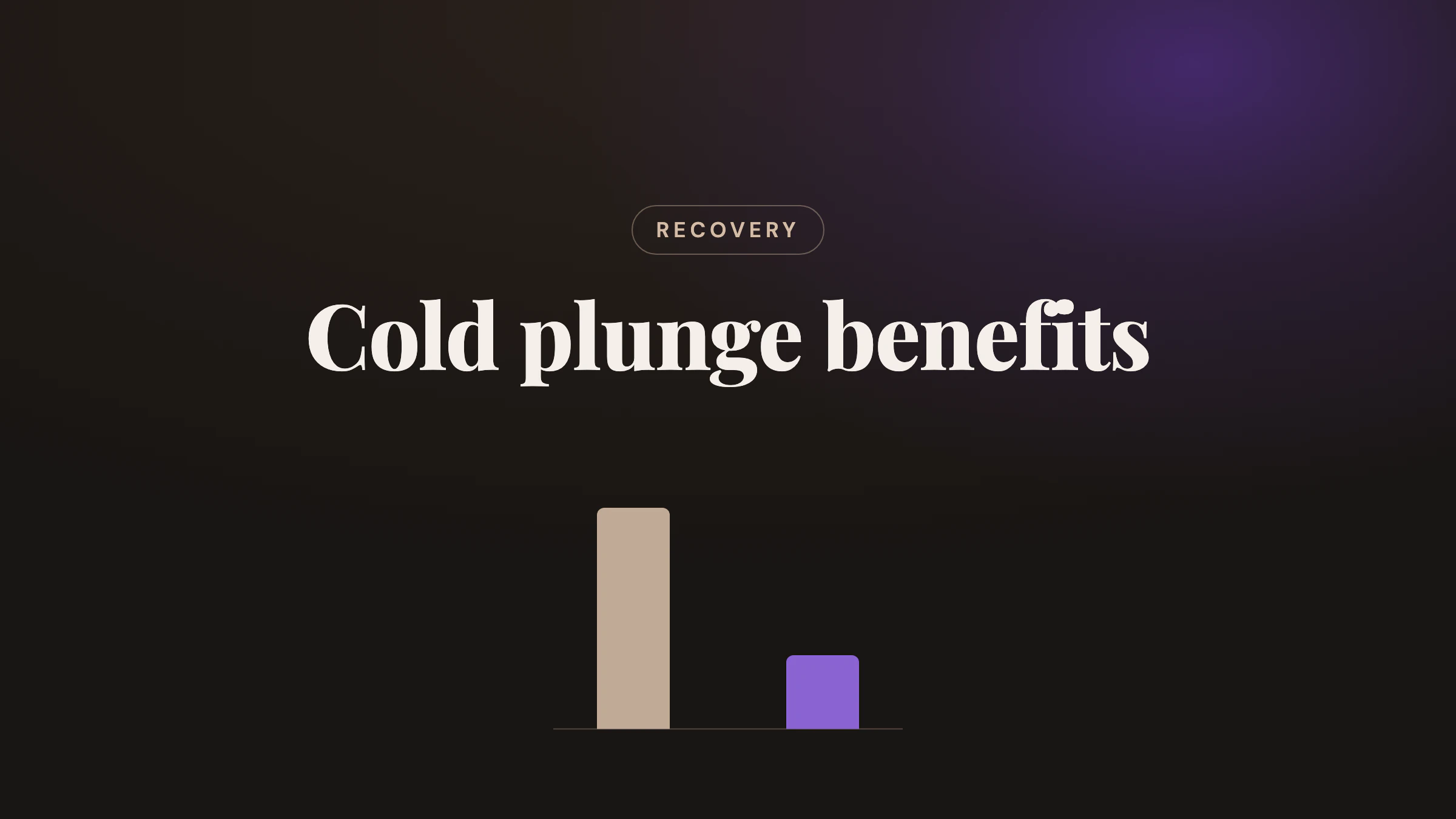
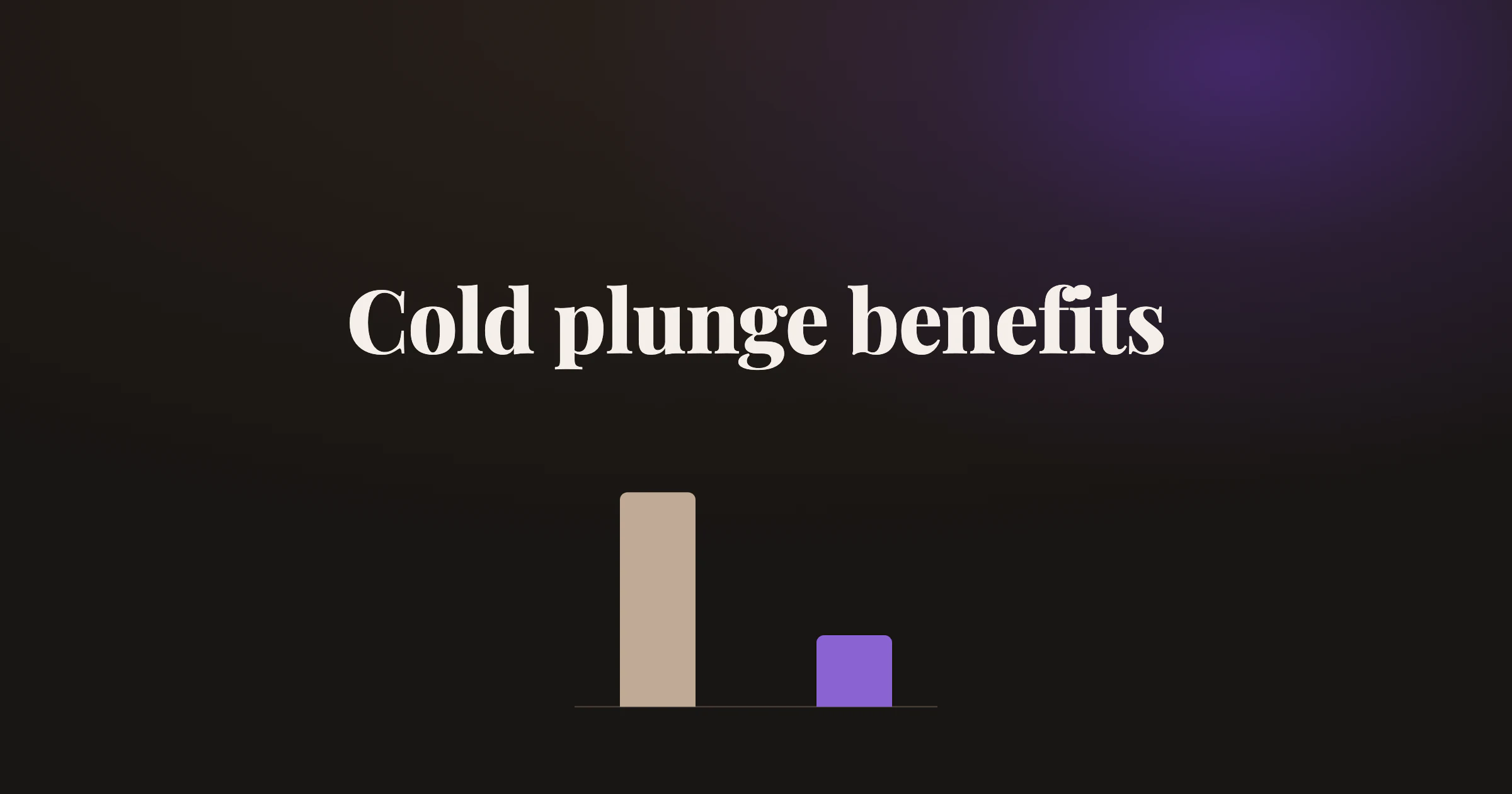
Yes, a little, when it comes straight after lifting. One trial tested exactly that: 21 young men, legs trained twice a week for 12 weeks. After each session, one group sat in 10 °C (50 °F) water for 10 minutes; the other cycled easily. The plunge group gained 103 grams of thigh muscle (0.23 pounds), the cyclists 309 (0.68 pounds). Strength rose less, too.
| Group | Muscle gained, grams |
|---|---|
| Easy cycling after each session | 309 |
| 10 minutes in 10 °C water after each session | 103 |
One catch: those men averaged 21. Pooled, 8 trials with 116 adults pointed to a small brake on muscle growth (-0.22), in studies of fair to poor quality, all in adults aged 20 to 26. One included women; none studied older adults. For women and anyone over 40, that is a starting point, not a measured effect.
A review of 10 studies with 170 people, 92 percent men, found gains trimmed a little (-0.23, small; -0.31, also small, with only the trained limbs under water). Whole-body plunges showed no significant difference (-0.08), in a small subset. If strength is your goal, rest after lifting: a 2026 ranking put passive rest above every cold protocol.
Why? In small trials of young men, after 20 minutes at 8 °C (46 °F) a cooled thigh held under half the blood of the warm one, and over 2 weeks it built muscle protein more slowly.
Cold plunge before or after a workout: plan by day, not by hour
Keep plunges off your strength days. The trials put people in the water within 15 minutes of finishing, and whether waiting longer changes the effect is unknown. After one leg session in 9 young men, growth signals rose less in samples taken up to 48 hours later. After cardio, go ahead: a review of 8 studies found no measurable change in endurance gains (-0.07).
The muscle trials used 10 to 20 minutes at 10 to 15 °C (50 to 59 °F); none tested a 1- to 3-minute plunge.
Take a week with two strength days. Lift Monday and Thursday, no plunge after. Run, ride or play a sport Tuesday and Friday, then plunge if you like. Rest days are open. More on cardio and strength training in one week.
| Day | Session | Plunge |
|---|---|---|
| Mon | Strength | No plunge after |
| Tue | Run or ride | Plunge after |
| Wed | Rest | Plunge any time |
| Thu | Strength | No plunge after |
| Fri | Cardio or a sport | Plunge after |
| Sat | Long walk | Optional |
| Sun | Rest | Optional |
No other slot on a strength day? Plunge as far from the session as the day allows; only the first 15 minutes were tested.
Soreness and recovery: what a plunge does the next day
Expect to feel less sore. A 2026 review of 14 reviews named less soreness the most consistent benefit, with effects from small to large (-0.37 to -1.04). Those reviews reused the same trials, though, so its size is uncertain. A 2022 review of 52 studies found people felt less sore 24 hours after hard exercise (-0.89, large); strength recovery was not clearly different.
In 9 trained men, muscle inflammation showed no significant difference from easy cycling. The 2026 “worse than nothing” headline? In a trial with 40 adults, strength was back to about 82 percent of its starting level 72 hours after cold water, against 88 to 89 percent after heat or nothing. That gap was not statistically significant.
HRV rose right after exercise with cold: check yours with the HRV tool and see raising your HRV.
Cold plunge benefits for mood, colds and metabolism: what was measured
You may feel more alert, but that is not a proven mood fix. After 5 minutes in 20 °C (68 °F) water, 33 adults new to cold felt more active and alert (no control group). A 2026 review of 13 studies with 4,105 adults leaned toward better mood, yet the evidence does not yet show a benefit for mood, stress, wellbeing or depression. An earlier review found stress lower at 12 hours only, not right after.
The 250 percent dopamine rise came from a full hour in 14 °C water (57 °F), measured in young men's blood.
Colds: in a trial with 3,018 working adults aged 18 to 65, a cold finish to the shower went with 29 percent less sickness absence than in controls; days ill were not clearly different.
Fat: your body burns extra energy while you are in the water. The brown-fat studies measured heat and insulin, not weight: insulin sensitivity rose about 43 percent in 8 people with type 2 diabetes after 10 days of mild cold (no control group), and 8 young men who swim in winter made more heat in the cold than controls. A review of 104 studies called less body fat possible but debated. After 30 minutes at 16 °C (61 °F), 15 active adults ate about 230 kcal more at the next meal than after warm water.
| Outcome | Who was studied | What changed | Certainty |
|---|---|---|---|
| Muscle growth from lifting | 8 trials, 116 adults aged 20 to 26, mostly men | Less growth with cold water right after lifting; small effect (−0.22) | low |
| Strength from lifting | 10 studies, 170 people, 92 % men | Smaller gains; small effect (−0.23); whole-body immersion alone (small subset): no significant difference | low to moderate |
| Endurance gains | review of 8 studies, regular plunges during training | No measurable change (−0.07) | low to moderate |
| Soreness the next days | umbrella review of 14 reviews | Less soreness, the most consistent effect (effect sizes −0.37 to −1.04 across reviews); reviews reuse the same trials, size uncertain | low |
| Mood, stress, wellbeing | 13 studies, 4,105 adults (showers, plunges, winter swimming) | Leaned toward benefit, wide uncertainty; benefit not established | low |
| Sick days off work (cold showers) | 1 trial, 3,018 working adults aged 18 to 65 | 29 % fewer sick days off work; days of illness not significantly different | moderate |
How cold, how long, how often: start safely
Start at 10 to 15 °C (50 to 59 °F), chest-deep, head out, someone nearby. Stay 30 seconds to a minute, two or three times a week, and build toward 2 or 3 minutes. Is a 3-minute plunge safe? Three minutes at 10 to 15 °C is where this start ends; the main risks are the cold shock of the first seconds and heart conditions.
Expect a gasp: the cold shock of the first seconds, then fast breathing. In cold-water swimming this reflex carries a risk of death for people new to it, and heart disease, even undiagnosed, makes rhythm trouble more likely. Breathe out slowly: face under water with a held breath is suspected in some sudden deaths.
It gets smaller. After about 4 immersions, the heart-rate jump shrank by 14 beats a minute (17 groups, 145 people), and breathing sped up less.
| Change after about 4 immersions | Value | Pooled from |
|---|---|---|
| beats a minute smaller heart-rate jump | 14 | 17 groups, 145 people |
| breaths a minute smaller rise in breathing rate | 8 | 12 groups, 73 people |
The 10 to 15 minutes of recovery protocols are for athletes after hard sessions, not for a start.
Your plan for this week
- Mark your strength days: no plunge after them.
- Plunge after cardio or on a rest day.
- Start with 30 seconds to a minute; build once the gasp eases.
One slip to avoid: plunging after every lift because the tub is there. Plan the lifting first: strength training after 40.
More health topics to explore
References
- Roberts LA et al. — Post-exercise cold water immersion attenuates acute anabolic signalling and... (2015)
- Liang W et al. — Cold-Water Immersion for Post-exercise Recovery: An Overlap-Aware Umbrella... (2026)
- Ngandeu Schepanski S et al. — Cold-water exposure and psychological outcomes in adults: a systematic... (2026)
- Piñero A et al. — Throwing cold water on muscle growth: A systematic review with meta-analysis... (2024)
- Grgic J — Effects of post-exercise cold-water immersion on resistance training-induced... (2023)
- Yu T et al. — Cold water immersion protocol optimization across exercise modalities: a... (2026)
- Betz MW et al. — Postexercise Cooling Lowers Skeletal Muscle Microvascular Perfusion and... (2025)
- Fuchs CJ et al. — Postexercise cooling impairs muscle protein synthesis rates in recreational... (2020)
- Malta ES et al. — The Effects of Regular Cold-Water Immersion Use on Training-Induced Changes... (2021)
- Moore E et al. — Impact of Cold-Water Immersion Compared with Passive Recovery Following a... (2022)
- Peake JM et al. — The effects of cold water immersion and active recovery on inflammation and... (2017)
- Bayne F et al. — Comparative effects of thermal recovery strategies on strength, muscle... (2026)
- Berjisian E et al. — Strategic Application of Post-exercise Cold-Water Immersion to Enhance... (2026)
- Yankouskaya A et al. — Short-Term Head-Out Whole-Body Cold-Water Immersion Facilitates Positive... (2023)
- Cain T et al. — Effects of cold-water immersion on health and wellbeing: A systematic review... (2025)
- Srámek P et al. — Human physiological responses to immersion into water of different temperatures (2000)
- Buijze GA et al. — The Effect of Cold Showering on Health and Work: A Randomized Controlled Trial (2016)
- Hanssen MJ et al. — Short-term cold acclimation improves insulin sensitivity in patients with... (2015)
- Søberg S et al. — Altered brown fat thermoregulation and enhanced cold-induced thermogenesis... (2021)
- Esperland D et al. — Health effects of voluntary exposure to cold water - a continuing subject of... (2022)
- Grigg MJ et al. — Effects of cold-water immersion on energy expenditure, ad-libitum energy... (2025)
- Knechtle B et al. — Cold Water Swimming-Benefits and Risks: A Narrative Review (2020)
- Shattock MJ et al. — 'Autonomic conflict': a different way to die during cold water immersion? (2012)
- Barwood MJ et al. — Habituation of the cold shock response: A systematic review and meta-analysis (2024)
About this article · Written by the huuman Team. Our content is based on peer-reviewed research and clinical guidelines. We follow editorial standards grounded in scientific evidence.
This article is for educational purposes only and does not constitute medical advice. Health and training decisions should be discussed with qualified professionals.